
Nuisance
A common law tort for interference with land use.

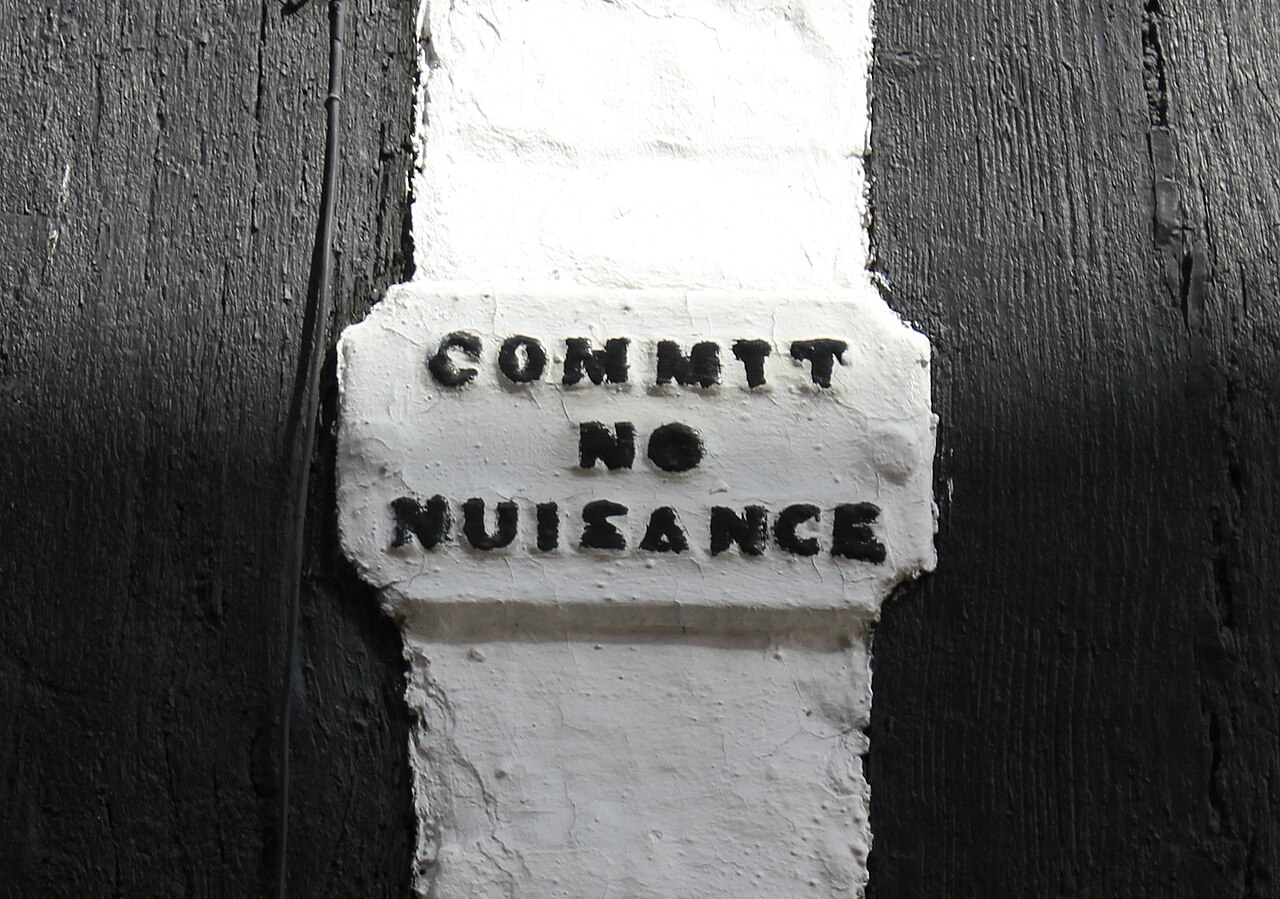
Meirion · CC BY-SA 2.0
Nuisance is a common law tort that addresses activities or conditions causing offence, annoyance, trouble, or injury. It is one of the oldest causes of action in common law, protecting the right to quiet enjoyment of land and distinguishing between public and private interference.
- field
- Common law tort
- known_for
- Protecting quiet enjoyment of land; oldest common law causes of action
- type
- Legal doctrine
Lore & Background
Nuisance derives from the Latin 'nocere' (to hurt) and encompasses both public and private forms. Public nuisance, defined by Sir James Fitzjames Stephen, involves acts or omissions that obstruct or inconvenience the public's common rights. Private nuisance concerns interference with specific individuals' rights to quiet enjoyment of their land, excluding trespass. The law distinguishes between material injury to property and 'sensible personal discomfort'.
Reader's Guide
Nuisance law historically provided only damages as a remedy, but courts of equity later allowed injunctions to prevent recurring nuisances. In the late 19th and early 20th centuries, competing property uses made nuisance law difficult to administer, leading to zoning systems that often override nuisance claims. Modern environmental laws are adaptations of nuisance doctrine to address harms that cross property boundaries in complex ways. The law and economics movement has analyzed efficient remedies, as seen in cases like Boomer v. Atlantic Cement Co., where permanent damages were allowed instead of a full injunction. The office of Inspector of Nuisances, established in the 19th century, evolved into modern environmental health officers in the UK and similar roles elsewhere.
Did You Know?
- Nuisance is one of the oldest causes of action in common law, with cases dating back nearly to the beginning of recorded case law.
- A public nuisance was defined by Sir James Fitzjames Stephen as an act or omission that obstructs or inconveniences the public in exercising rights common to all subjects.
- The law of nuisance distinguishes between material injury to property and 'sensible personal discomfort'.
The Architecture of the Tort
Nuisance stands as one of the oldest causes of action in common law, with recorded cases stretching back to the earliest days of legal documentation. At its core, the doctrine protects what is called the right of quiet enjoyment of land. When that enjoyment is disrupted to a legally significant degree, a tort is committed. The concept divides into two principal categories: public nuisance, which obstructs rights common to all members of the public, and private nuisance, which interferes with the rights of specific individuals. The term itself traces a linguistic path from the Latin nocere, meaning to hurt, through French noisance, into the archaic English nocence. Legally, the word operates in three distinct registers: it can name the offending activity or condition, describe the harm that activity produces, or denote the legal liability that emerges from their combination. Crucially, nuisance does not require that a neighbor has physically entered or stolen land; rather, it addresses activities conducted on one person's property that spill over and degrade another's use of theirs.
Thresholds, Standing, and the Limits of the Doctrine
Not every annoyance crosses the legal line into nuisance. The interference must rise above what is merely aesthetic or expected in ordinary property use. A neighbor painting their house a vivid purple may offend the eye, yet it does not constitute a legal wrong. Similarly, the sound of a crying baby, while undeniably irritating, is regarded as an inherent part of residential life and cannot be restrained under nuisance law. Normal, expected uses of a property generally fall outside the doctrine's reach. The law distinguishes between cases where the alleged conduct has produced material injury to property and those where it has caused what is termed sensible personal discomfort. Standing to bring a private nuisance claim requires a recognized interest in the land—ownership, a lease, or an easement—and exclusive possession is typically necessary. A mere licensee, as established in Oldham v Lawson, lacks the title to sue, whereas the actual property owner does. Visitors or those without a recognized interest in the land are not covered by the quiet enjoyment protection.
From Common Law to Zoning and Environmental Statutes
By the late nineteenth and early twentieth centuries, the nuisance doctrine faced a practical crisis. As industrialization multiplied competing property uses, neighbors increasingly posed nuisances to one another, and the cost of resolving these disputes through litigation became prohibitive. Most jurisdictions responded by adopting land-use planning systems, particularly zoning, which pre-determine which activities are permissible in a given area. Under this regime, zoning generally overrules nuisance: a factory lawfully operating within an industrial zone cannot be enjoined by residents in an adjacent residential district, even if the activity would otherwise qualify as a nuisance. In jurisdictions lacking such planning frameworks, nuisance law remains the primary mechanism for regulating land use. Modern environmental legislation represents a further adaptation of the doctrine, extending its logic to situations where a person's property use causes harm to another's land or health at a considerable distance, involving causal chains that historic nuisance categories were never designed to accommodate.
Remedies and the Economics of Injunctions
Under the earliest common law, the sole remedy for a nuisance was the payment of damages. The emergence of equity courts expanded the toolkit, introducing the injunction—a court order compelling a defendant to cease the offending activity, backed by the threat of contempt sanctions for noncompliance. The law-and-economics movement later brought analytical rigor to choosing between these remedies. The landmark New York case Boomer v. Atlantic Cement Co. illustrated the tension: a cement plant's emissions disturbed numerous neighbors, yet the expense of full compliance with an injunction would have vastly exceeded the fair value of the plaintiffs' ongoing losses. The court permitted the plant owner to effectively purchase the injunction by paying what was termed permanent damages, theoretically calculated as the net present value of all future harm the plaintiffs would suffer. This approach balanced the competing economic interests of both parties, acknowledging that a blanket prohibition was not always the most efficient resolution.
Gallery

Frequently Asked Questions
What is Nuisance in civil law?
Nuisance is a common law tort that covers activities or conditions causing offence, annoyance, trouble, or injury to others. It functions as a legal doctrine specifically designed to address interference with how someone uses their land.
What right does Nuisance protect?
Its core purpose is safeguarding a landowner's right to the quiet enjoyment of their property. It gives affected parties a cause of action when someone's conduct unreasonably disrupts that peaceful use.
How old is Nuisance as a legal concept?
It ranks among the oldest causes of action recognized in common law. Centuries of judicial decisions have shaped its principles long before modern statutory torts emerged.
What are the main categories of Nuisance?
The doctrine splits into public nuisance, which harms a community or the general public, and private nuisance, which targets a specific landowner's use and enjoyment of their property. This distinction determines who can bring a claim and what relief is available.
Why is Nuisance important in the remedies landscape?
It fills a gap that contract law and property law alone cannot address, giving neighbors and communities a tool against ongoing interference. As one of the foundational torts, it underpins much of the broader civil remedies framework for land-related disputes.
More in Civil Law And Remedies 1-20
Spotted an error? Know more?
This is a living reference — every entry is fact-audited, and reader corrections feed straight into our audit queue. Suggest an edit · See this site's audit record