
Lawsuit
A civil court proceeding initiated by a plaintiff against a defendant.

Rrmmll22 · CC BY-SA 4.0
A lawsuit is a proceeding by one or more parties (the plaintiff or claimant) against one or more parties (the defendant) in a civil court of law. It is a central mechanism in the common law adversarial system for resolving disputes involving issues of private or public law.
- field
- Civil law procedure
- known_for
- Formal legal proceeding for resolving disputes in court
- related_terms
- Litigation, plaintiff, defendant, complaint, answer
Lore & Background
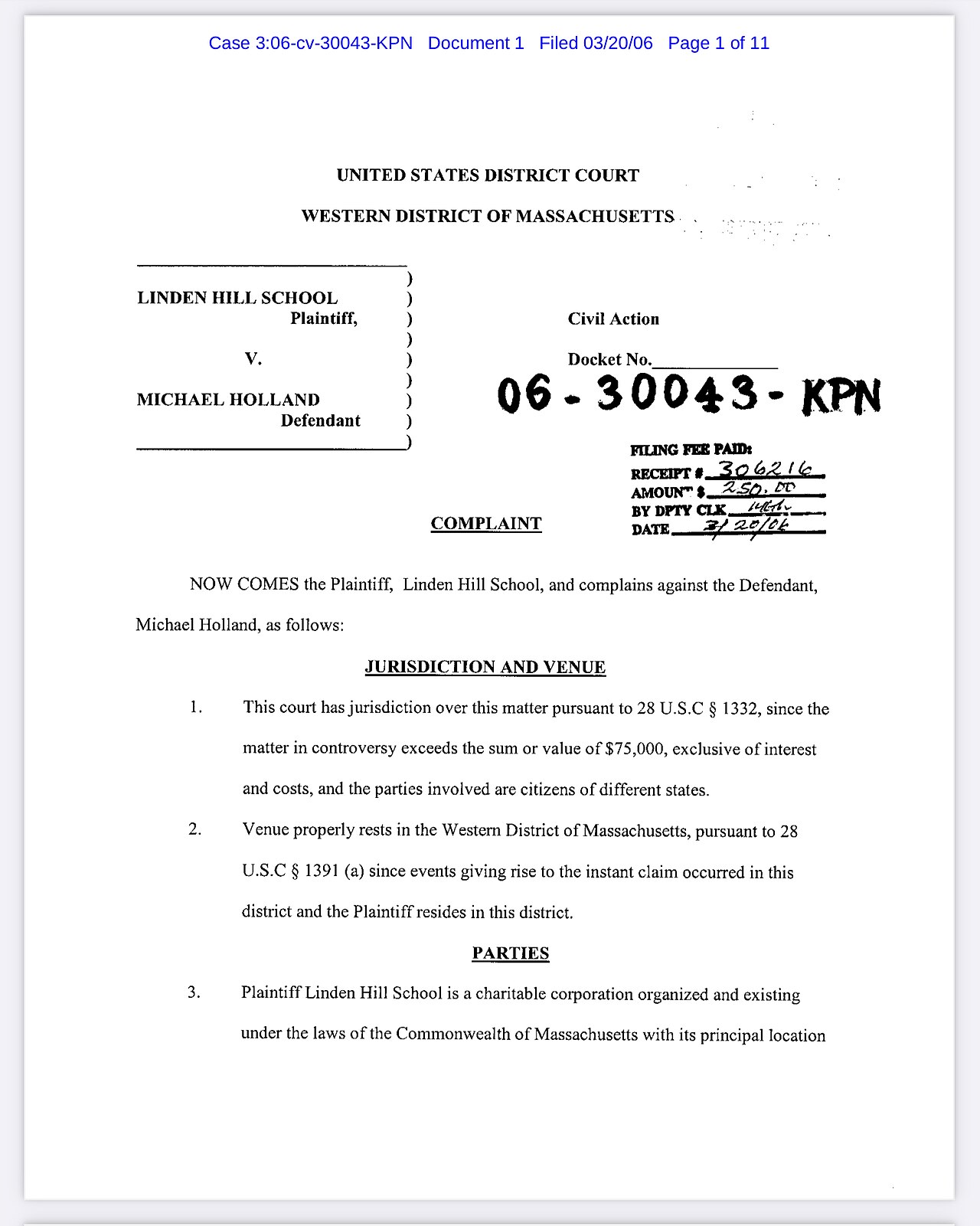
A lawsuit begins when a complaint or petition, known as a pleading, is filed with the court. The complaint explicitly states that one or more plaintiffs seek damages or equitable relief from one or more stated defendants, and includes relevant factual allegations. The plaintiff must select the proper venue with proper jurisdiction. The clerk of court signs or stamps a summons, which is served on the defendant together with a copy of the complaint, notifying them of the suit and the time limit to reply. The defendant must file an answer stating defenses, which may include challenges to jurisdiction and counterclaims. In some jurisdictions, a lawsuit begins when the summons and complaint are properly served, without any filing with the court until a dispute arises.
Reader's Guide
The lawsuit is a foundational tool in civil law, allowing individuals, businesses, and even the state to seek legal or equitable remedies. Its significance lies in its structured process—from pleading through trial or settlement—governing how disputes are resolved. The article notes that about 98 percent of civil cases in U.S. federal courts are resolved without trial, highlighting the prevalence of settlement. Lawsuits can become complicated with multiple parties, cross-claims, and counterclaims, and procedural rules vary by jurisdiction. The etymology traces 'lawsuit' to Old French and Latin roots meaning 'to pursue,' reflecting the adversarial nature. The legacy of the lawsuit is its role in enforcing rights, awarding damages, and issuing injunctions, while also illustrating the need for comprehensive legal research beyond simple online searches, as post-ruling outcomes may not be fully captured.
Did You Know?
- The term 'lawsuit' derives from the combination of 'law' and 'suit,' with 'suit' from Old French 'suite' meaning to pursue.
- About 98 percent of civil cases in United States federal courts are resolved without a trial.
- In some jurisdictions, a lawsuit begins when a summons and complaint are served, without any filing with the court until a dispute develops.
- The word 'sue' derives from Old French 'suir' meaning to pursue, from Latin 'sequi.'
The Architecture of Civil Dispute
A lawsuit is fundamentally a structured confrontation in a civil court, where one or more parties who claim to have suffered loss due to another's conduct seek a legal or equitable remedy. The party initiating this action is called the plaintiff or claimant, while the party being challenged is the defendant. The defendant faces a critical obligation: they must respond to the plaintiff's complaint, or they risk a default judgment being entered against them. If the plaintiff prevails, the court can impose a range of orders—awarding damages, granting restitution, issuing temporary or permanent injunctions to either compel or prevent specific actions, or rendering a declaratory judgment to forestall future disputes. Beyond private disputes between individuals, businesses, and non-profits, lawsuits also intersect with public law, where a state can appear as either a plaintiff enforcing its own statutes or a defendant facing challenges to the legality of its actions or claims for monetary damages caused by its agents. The entire process of conducting such a civil action is known as litigation, with the parties called litigants and their attorneys called litigators.
Roots in Language
The word "lawsuit" carries a linguistic heritage stretching back through centuries. It is a straightforward combination of "law" and "suit," where the latter element traces its lineage to the Old French "suite" or "sieute," meaning to pursue or follow. That French term, in turn, descended from the Latin "secutus," the past participle of "sequi," which conveyed the sense of attending to or following something. The related verb "sue" follows an almost identical path, arriving from the Old French "suir" or "sivre," again meaning to pursue or follow after, and likewise rooted in the Latin "sequi." This shared etymological thread underscores that the very concept of a lawsuit was, at its linguistic origin, an act of pursuit—of following a claim through the corridors of justice. The archaic phrasing "suit in law" still lingers in a small number of statutes that remain in force today, serving as a quiet reminder of how the terminology has evolved while the underlying mechanism of pursuing a legal remedy has remained remarkably consistent.
The Maze of Procedure
The conduct of a lawsuit in a common law adversarial system is governed by procedural rules drawn from statutory law, case law, and constitutional provisions, particularly the right to due process. These rules vary enormously from one jurisdiction to another and can even differ between courts within the same jurisdiction. Litigants bear the responsibility of understanding and complying with all relevant procedural requirements, or they must retain competent counsel who can manage that compliance on their behalf. The stakes of noncompliance are severe: failure to follow procedural rules can impose serious limitations on one's ability to present claims or defenses at trial, or can result in the outright dismissal of the case. In federal systems, the complexity deepens further—a federal court might be applying state law, or a state court might apply the law of another state. Questions of jurisdiction, personal jurisdiction over a defendant, and whether a plaintiff has standing to participate can all muddy the waters. Domestic courts may also be called upon to apply foreign law or act against foreign defendants whose assets lie beyond their enforcement reach.
From Filing to Resolution
A lawsuit formally begins when a complaint or petition—collectively called a pleading—is filed with the court. This initial document must clearly identify the plaintiffs, the defendants, the damages or equitable relief sought, and the factual allegations underpinning the legal claims. Because the complaint establishes the factual and legal foundation for the entire case, it is regarded as the most consequential step in civil litigation, setting the framework for every claim that will be asserted throughout the proceeding. While pleadings can ordinarily be amended by motion, the complaint's role as the case's architectural blueprint cannot be overstated. Despite this formal structure, the vast majority of lawsuits never reach trial. In the United States federal courts, approximately 98 percent of civil cases are resolved without a full trial, typically through settlement. Even so, the path to resolution can be extraordinarily complicated, with multiple parties joining a single action, cross-claims and counterclaims multiplying between participants, and courts retaining the power to sever claims into separate proceedings when factual overlap is insufficient.
Gallery





Frequently Asked Questions
What is Lawsuit in Civil Law And Remedies?
A lawsuit is a formal proceeding in a civil court where one or more claimants bring a dispute against one or more opposing parties. It operates as the core structural mechanism within the common law adversarial system for settling private or public law disagreements.
What role does Lawsuit play in the canon?
Lawsuit functions as the primary procedural vehicle through which a plaintiff seeks a court-ordered remedy against a defendant. It provides the structured framework—complaint, answer, and trial—within which a dispute is formally adjudicated.
How does a Lawsuit's arc conclude?
A lawsuit reaches its end when the court renders a final judgment or when the parties mutually settle their claims. Either outcome formally discharges the dispute and closes the proceeding between the involved parties.
Why is Lawsuit considered central to the Civil Law And Remedies series?
It is the foundational mechanism by which civil rights are enforced and disputes are resolved through an organized court process. Without the lawsuit structure, parties would lack a standardized avenue for seeking legal redress in an adversarial system.
What key terms are linked to Lawsuit?
The closely associated concepts include litigation, plaintiff, defendant, complaint, and answer. Together these terms describe the essential participants and procedural stages that make up the lawsuit proceeding.
More in Civil Law And Remedies 1-20
Spotted an error? Know more?
This is a living reference — every entry is fact-audited, and reader corrections feed straight into our audit queue. Suggest an edit · See this site's audit record